
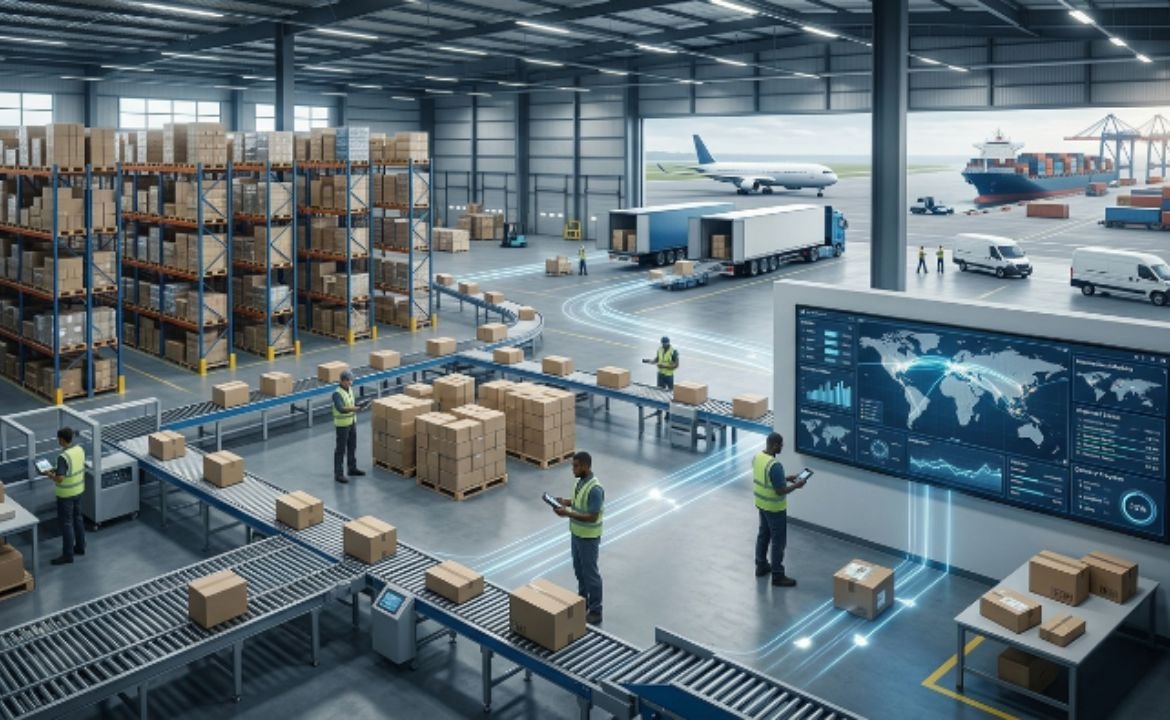
For many companies, international expansion looks simple on a strategy slide: enter a new market, reach more customers, and create another source of revenue. Operationally, however, growth across borders adds complexity to almost every order. Inventory may sit in the wrong location. Transportation plans may depend on several providers. Returns can become expensive and slow. Customer expectations remain local even when the supply chain is international.
This is why global logistics services should not be treated as a back-office function that begins after a sale. For a growing business, logistics affects working capital, customer experience, market-entry speed, and the ability to scale without adding unnecessary operational friction.
The strongest logistics model is not necessarily the one with the most individual services. It is the one that connects transportation, warehousing, fulfillment, delivery, returns, and information flows around the commercial needs of the business. For companies preparing to expand internationally, that shift can make the difference between simply shipping abroad and building a repeatable cross-border operation.
1. International growth changes the logistics question
A domestic business can often optimize around a relatively stable set of variables: familiar delivery expectations, established inventory locations, and a limited number of transport routes. Cross-border growth changes that equation.
The first question is no longer just, “How do we move this shipment?” It becomes a set of connected questions:
- Where should inventory be positioned before demand becomes predictable?
- Which orders should move cross-border and which should be fulfilled locally?
- How much stock should be committed to a new market?
- How will delivery performance be managed when several partners are involved?
- What happens when a customer returns an item?
- Can the business see inventory and order status across markets?
These are business questions as much as logistics questions. They influence cash tied up in stock, the speed at which a company can test a new market, and the operational attention required to support growth.
A fragmented approach can work at low volume. A company may use one provider for international transportation, another for storage, a third for local delivery, and separate processes for returns. But as order volume and market coverage increase, coordination costs rise. Teams spend more time reconciling information, resolving exceptions, and managing handoffs.
That is the point at which global logistics services become a management issue rather than a shipping issue.
2. Build the operating model around demand, not around providers
A common mistake in international expansion is to design the supply chain around whichever services are easiest to buy first. A better approach is to start with the demand model.
A brand testing a new country with uncertain demand may prefer to keep inventory concentrated and use cross-border transportation until sales become more predictable. An established e-commerce seller with consistent order volume may benefit from holding selected products closer to customers. A retailer serving both online customers and business buyers may need inventory that supports multiple channels from the same network.
The right model depends on variables such as order frequency, product size, average order value, seasonality, return rate, required delivery experience, and the amount of working capital the business can commit.
This demand-first approach also helps companies avoid expanding physical infrastructure too early. More warehouses do not automatically create a better supply chain. Each additional inventory location creates forecasting, replenishment, systems, and control requirements. The objective should be to place stock where it creates a measurable commercial advantage, not simply to create a larger footprint.
3. Treat inventory as a growth asset and a financial constraint
International expansion often creates pressure to “have stock everywhere.” Local availability can improve responsiveness, but inventory distributed across too many markets can quickly absorb working capital.
Businesses should segment products rather than apply one stocking rule to every SKU. Fast-moving items with predictable demand may justify local inventory. Slow-moving or highly variable products may be better served from a regional location or through cross-border shipping. New products may require a test-and-learn period before the company commits meaningful stock to a market.
This is where warehousing and fulfillment decisions connect directly with business planning. A useful logistics partner should help a company understand not only how goods will be stored, but how the network can respond as demand changes.
Useful metrics include inventory turnover, stockout frequency, days of inventory, order-cycle time, return rate, and the proportion of orders requiring exception handling. These measures should be considered together. Faster delivery that requires excessive inventory may not be sustainable; lower inventory that creates frequent stockouts may damage growth.
The goal is a system that can adapt without forcing the company to rebuild its logistics model every time demand changes.
4. Reduce handoffs before trying to optimize each handoff
Cross-border logistics contains many transition points: origin pickup, export processes, international transportation, destination handling, warehousing, order fulfillment, last-mile delivery, and reverse logistics. Every handoff introduces the possibility of delay, information loss, unclear responsibility, or inconsistent service standards.
Companies often respond by trying to optimize each provider separately. That can improve individual steps but still leave the overall customer journey fragmented.
A more useful question is: how many operational boundaries does one order have to cross before it reaches the customer?
Reducing unnecessary handoffs can simplify accountability and make exception management easier. For growing companies with lean operations teams, this matters. A logistics design that requires constant manual coordination may become a hidden barrier to expansion even if individual transport rates appear competitive.
Integrated logistics does not mean a business must use one provider for everything. It means the operating model should have clear ownership, shared information, consistent service rules, and a deliberate plan for how activities connect.
5. Make visibility practical, not decorative
“Supply chain visibility” is often discussed as a technology feature, but visibility has limited value unless it supports decisions.
A dashboard showing that a shipment is delayed is useful. A system that helps the team understand which customer orders are affected, whether inventory should be reallocated, and what action should be taken is more valuable.
For growing businesses, useful visibility operates at three levels. The first is inventory visibility: knowing what is available and where it is located. The second is order visibility: understanding fulfillment and delivery status. The third is exception visibility: identifying problems early enough to respond before they become customer-service issues.
This is why technology and operations should be evaluated together when selecting global logistics services. A sophisticated interface cannot compensate for weak execution, while strong physical operations become harder to scale when information is fragmented across systems and partners.
The best question is not “Does the provider have a platform?” It is “What decisions will our team be able to make faster or more accurately because of the information it provides?”
6. Plan reverse logistics before returns become a problem
Returns are easy to underestimate when entering a new market because the primary focus is usually on getting products to customers. But a cross-border sales model is incomplete without a clear reverse process.
Businesses should define where returns will be received, how products will be inspected, which items can return to saleable inventory, and how information will flow back to customer-service and finance teams. If every returned product must travel internationally before it can be inspected or restocked, costs and processing times can increase quickly.
Reverse logistics also provides commercial information. High return rates can reveal problems with product descriptions, packaging, quality, sizing, or delivery damage. When return data is connected with fulfillment and inventory information, logistics becomes a source of operational feedback rather than simply a cost of doing business.
7. Evaluate logistics partners by their ability to support change
The logistics model that works when a company enters its first overseas market may not be the model it needs two years later. Businesses should evaluate potential partners not only on current requirements but also on how easily the relationship can evolve.
Key questions include:
- Can the network support both cross-border shipping and local fulfillment as demand changes?
- Can warehousing, transportation, last-mile delivery, and returns be coordinated under a consistent model?
- Can services support different product types and sales channels?
- Is operational data accessible enough to support inventory and customer-service decisions?
- How are service exceptions handled and escalated?
- Can the provider adapt without forcing a full redesign of the supply chain?
This is where companies should distinguish between buying individual logistics activities and buying an integrated operating capability.
JINGDONG Logistics provides an example of the latter approach. Its international business covers warehousing, transportation, last-mile delivery, cross-border logistics, and end-to-end supply chain management, while its international brands include JoyLogistics and JoyExpress. The company also integrates technology, automation, and data-driven operations into its logistics model.
For businesses evaluating global logistics services for international growth, the relevant lesson is not that every company needs the same network or service configuration. It is that logistics capabilities should be designed around the business model and connected closely enough to evolve with it.
8. Turn logistics into a controlled growth system
International expansion creates uncertainty. Demand is harder to forecast, customer expectations vary by market, and operational mistakes can become more expensive when they occur far from the company’s home base.
A resilient logistics strategy does not remove that uncertainty. It gives the business more ways to respond to it.
That means keeping inventory decisions flexible, reducing unnecessary handoffs, connecting physical operations with useful data, planning returns early, and choosing partners based on their ability to support change rather than a single shipment or rate card.
For founders and business leaders, the most important shift is conceptual: logistics should be included in the growth plan from the beginning. Marketing can create demand in a new market, but the supply chain determines whether the business can serve that demand consistently and profitably.
Companies that treat logistics as an operating system for growth are better positioned to test markets, scale successful channels, and adapt when conditions change. The objective is not simply to move more goods across more borders. It is to build an international operation that remains manageable as the business becomes more complex.









Leave a Reply