
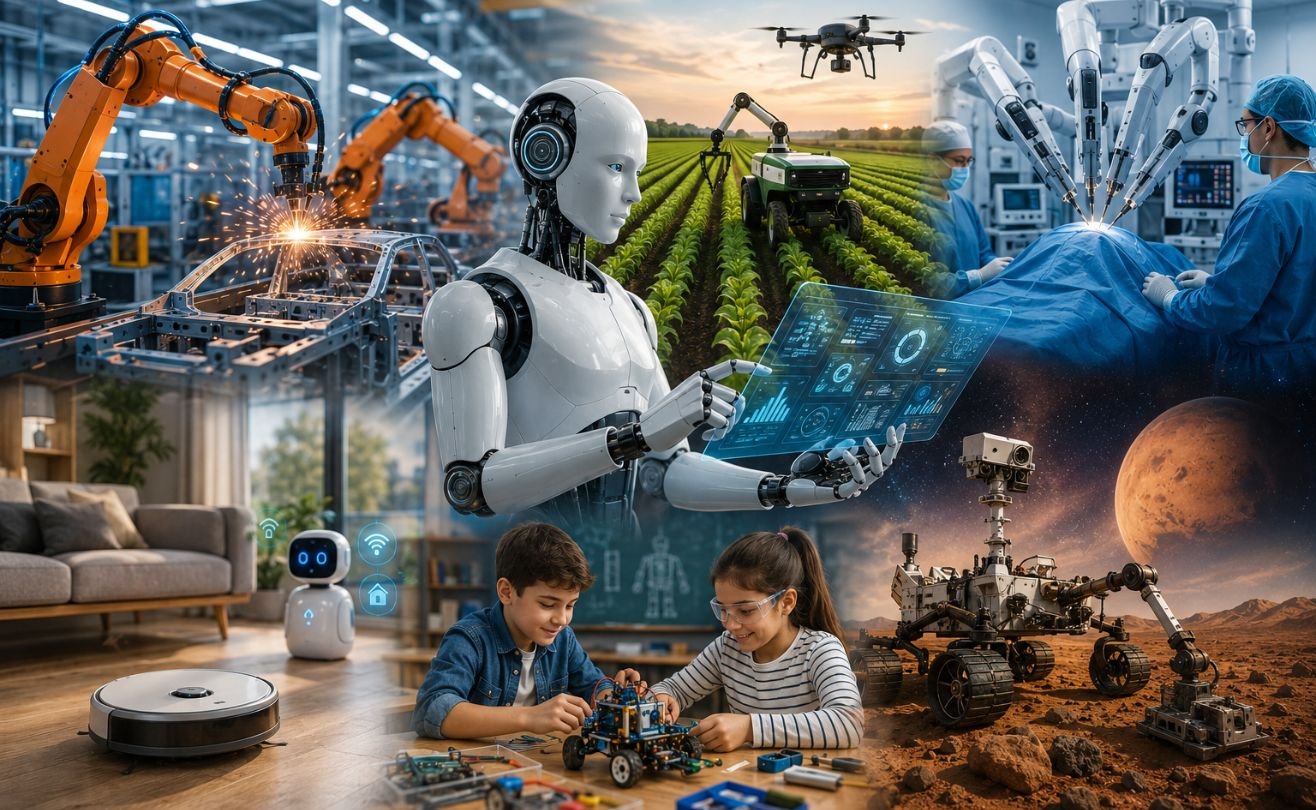
While Robots could have been a thing of fiction, a sci-fi movie, or locked inside an office of a factory, today Robot, a piece of equipment, assist in bringing surgeons’ hands into surgery room, harvest produce on farms, explore sites building for work, and even trains new talents, students, by imparting them with latest techniques This is a clear example of how robotics is changing the world across different industries and everyday life.
Now that we understand why robotics is revolutionizing our world, we can also grasp why businesses, governments, and individuals alike are investing so heavily in automation and smart machines. We can now see that contemporary robots don’t necessarily work instead of us and how their presence can make all of our activities safer, faster, and more accurate than before. From working in healthcare, production in all forms, or space, for example, the possibilities of robots are changing life. It seems that even smarter machines will follow us to work alongside us and our creative capacities, solving tough problems to enrich us all.
How Robotics Is Changing the World Across Various Sectors
The world has seen many advancements in science with the recent invention of technologies like robots. The 21st-century world has widely noticed robotics as it helps companies and the public to enhance output to a huge level. The public sector is making better use of automation to provide even faster and more secure assistance, while on the other hand, many people don’t have to do tedious work. Instead, employees can use their brains for creative work and decision-making.
Robots have played a huge role in almost all the major industries, which include the following:
Manufacturing and industrial automation
Robotic process automation has most famously impacted the manufacturing industry; robots assemble cars, package products, assemble steel beams, or inspect finished parts precisely. With around-the-clock work that doesn’t require lunch breaks, efficiency goes up, costs come down, and production goes from days to minutes. Product quality stays consistent and dependable for the end user.
‘Cobots’ in modern factories don’t replace employees; instead, they do a more monotonous or physically strenuous task for a human, such as carrying heavy parts, placing screws, or removing hot parts from a machine. The humans remain on hand to supervise the robots, process unexpected errors, or repair breakdowns
Healthcare and Medical Innovation
The evolution of robotic use has also shown promising advancements in healthcare facilities across the globe. Surgeries are the first that come to mind, as robots, with the help of robotic-assisted techniques and tools, allow them to perform more precise and delicate operations through smaller holes, ultimately creating a decrease in pain and complication rates for the patients and even reducing the amount of hospital stay time. Hospitals have adopted robots for various other procedures, including the carrying of medical items and the transportation of medication to patient rooms or sections, as well as the sanitizing of the entire facility.
Several prosthetic robotic limbs have provided disabled individuals with improved autonomy and range of movement, while rehabilitation robotics aid in the rapid healing of patients after any form of operation.
Implementing such systems will result in better standards of care but, more vitally, will allow healthcare professionals in general, including nurses and doctors, to have time available to consider their diagnoses for patients along with prescribing treatment medication and overall patient treatment.
Relevance of robots to everyday life
Most of us use and run into robot technologies day to day, even though we’re probably mostly unaware. Automation has crept into our daily routines for comfort.
Smart Homes and Personal Assistance
Save time on household work tasks with the help of robot mowers, vacuums, and home assistants. Home robots also allow elderly members of the house to use the device for the house and security as well as to administer medicine reminders. Thanks to machine learning and artificial intelligence, these units are always able to better understand and predict user needs and work habits.
Robotics in Education, Agriculture, and Scientific Research
That impact can ripple the workplace outwards. In schools, farms, labs, and elsewhere, new uses for automation are always surfacing.
Robotics in Education
Early robotics experiences provide students with essential technical skill sets. Learning robotics with an educational robot develops kids’ coding ability, engineering aptitude, and logical reasoning with an aim to empower them not to regurgitate information but to design and innovate as well as engineer. Young minds are introduced to the future through the domains of coding & computational abilities for robotics that are highly sought-after in the emerging trends of technology, engineering, artificial intelligence & data science!
Smart Farming
Farming comes with multiple challenges, and it includes climate change and labor shortages. As new farming robots work efficiently and plant crops, watching crops for disease or for finding bugs from the ground, they can surely play a vital role and give accurate output that does not produce any bugs or waste any valuable parts. By using a camera or a flying drone, field information helps farmers to get better ideas about applying fertilizers on their fields, the irrigation process, etc. This demonstrates how robotics is changing the world by helping farmers increase productivity while reducing waste.
Space Exploration and Scientific Discovery
It is more and more possible for humans to explore space thanks to robotics. Today, there are robot astronauts that go beyond the limits where humans can’t go, such as planets farther away than we imagine, and transmit vital information to the Earth after gathering various materials there and analyzing the local environment. Some kinds of intelligent robots are also at work under the deep ocean and at active volcanoes in order to analyze geological phenomena while avoiding direct human participation so that humans can reduce risks.
Challenges and Future Opportunities in Robotics
Robotics does have great advantages, but as there are some very serious issues in regard to using robots, the world must act responsibly.
Workforce Changes
Automation took over quite some traditional work. Automation made some simple repetitive jobs more efficient and allowed some workers to educate themselves in order to adjust to new job offers caused by this automation and robots. The new jobs are, among others, robot development, robotics, computer science, cybersecurity, machine learning, or system development in robotics. Workforce training will ensure the change.
Ethical and security implications
As robots make even greater leaps, they also need more ethical considerations. Businesses have the responsibility to ensure robots always operate safely and secure information. Tech firms and governments work together to establish rules of responsible robotics. Protecting robotic data is also important
The Future of Robotics
The robot in charge: The current and continued improvements to artificial intelligence (AI), computer vision, machine learning (ML), and sensors will empower the newest robots like never before. Tomorrow’s robots may someday co-teach with their classroom instructors, help senior citizens with home-based tasks, come to the rescue after a natural disaster, or operate more meticulously in advanced surgery procedures. Instead of a robot replacing human intelligence altogether, we’re moving to a place where robots augment what we do with what machine intelligence can provide. The success in the workplace of tomorrow will hinge on people and robots working together more seamlessly than ever before.
Conclusion
We’re at the early chapters of the robotics revolution, but what the story has already told us can’t be discounted. Robotics enhances healthcare, makes factories more robust, fosters better education, revolutionizes agriculture, and unlocks new frontiers in science. However, we still must face robotics’ challenges with an investment in worker retraining, enhanced cyber protection, and a guide on ethical conduct.
Understanding how robotics is changing the world helps us prepare for a future where people and intelligent machines work together more effectively.
Robotics will truly show its worth in enabling us all to solve challenging problems with greater ease and security.
And as technology continues to progress, all who become familiar and work with this new breed of intelligence will position themselves to have a stronger hand in our own, brighter future—not just a brighter robot one.
FAQs
1. In what ways is robotics changing our world now?
Robotics is changing industry because it increases efficiency, accuracy, and productivity, because these increase productivity more rapidly.
2.Will robots be eating humans out of house and home?
Robots actually don’t replace your job at all – they work with and augment them, automating current ones while generating an entirely new set of one’s around their development, design, and operation
3. In which industries does robotics bring the most benefits?
Needless to say, the applications for robotics in this and many other industries are numerous and beneficial-but ultimately they all go towards increasing security, reducing costs, or improving operational productivity and output.
4. What do you think is the future of robotics?
Robotics provides solutions by: facilitating healthcare, reducing waste generation, enabling job opportunities or job creating jobs, increasing capacity in response to emergency and urgent attacks
-
How can youth prepare for future careers in robotics?
Young people interested in robot design, robot manufacturing or working with robots should have a strong foundation in math and science as well as an understanding of how to write computer programs to make computers and robots function.








Leave a Reply